
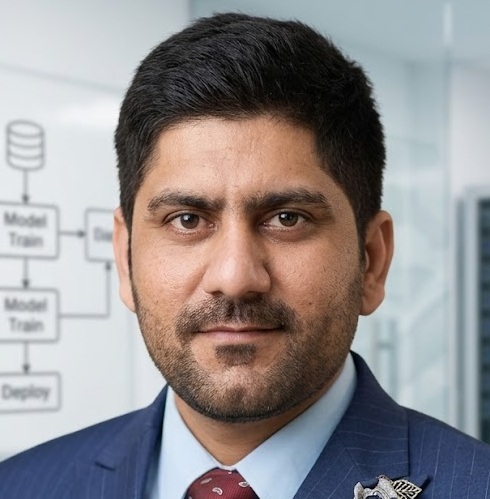
Shakeeb Murtaza
Pursuing reliable visual understanding from weak, scarce and noisy labels, from object localization to person re-identification and medical imaging.
Learning to see with fewer labels
Shakeeb Murtaza is a Postdoctoral Fellow at LIVIA, ÉTS Montréal, where he also completed his Ph.D. in 2025 on deep learning with minimal supervision for visual tasks. His research asks a deceptively hard question: how much visual understanding can a model reach when labels are scarce, weak, or noisy?
During his doctorate he focused on Weakly Supervised Object Localization (WSOL), localizing objects using only image-level labels. He contributed pseudo-labeling and self-supervised transformer methods (DiPS), class-activation co-localization for unconstrained videos (CoLo-CAM), text distillation (TeD-Loc), and a realistic evaluation protocol that exposed weaknesses in how WSOL is benchmarked.
His current work centers on Person Re-Identification, with interpretable, text-guided and part-based matching and test-time adaptation (InterPartAbility, DART3). He also works on medical and microscopy imaging, co-authoring the SR-CACO-2 super-resolution benchmark (NeurIPS 2024) and weakly-supervised histology adaptation, and on interpretable and explainable AI through counterfactual explanations, concept-controlled models and visual attribution.
He has authored 20+ peer-reviewed papers across venues including NeurIPS, WACV, CVPR workshops and the Pattern Recognition journal, and was named to the ÉTS Honour Roll in 2025.
What Shakeeb works on
Weakly Supervised Object Localization
Localizing objects from only image-level labels, in images and unconstrained videos.
Person Re-Identification
Interpretable, text-guided and part-based matching, with test-time adaptation.
Learning with Minimal Supervision
Weak, self-supervised and pseudo-labeling strategies for visual recognition.
Vision Transformers & Self-Supervision
Transformer-based localization and discriminative proposal sampling.
Medical & Microscopy Imaging
Microscopy super-resolution (SR-CACO-2) and weakly-supervised histology adaptation.
Interpretable & Explainable AI
Counterfactual explanations, concept-controlled models and visual attribution.
Recent & representative work
InterPartAbility: Text-Guided Part Matching for Interpretable Person Re-Identification
DART3: Leveraging Distance for Test-Time Adaptation in Person Re-Identification
TeD-Loc: Text Distillation for Weakly Supervised Object Localization
CoLo-CAM: Class Activation Mapping for Object Co-Localization in Weakly-Labeled Unconstrained Videos
A Realistic Protocol for Evaluation of Weakly Supervised Object Localization
SR-CACO-2: A Dataset for Confocal Fluorescence Microscopy Image Super-Resolution
Source-Free Domain Adaptation of Weakly-Supervised Object Localization Models for Histology
Leveraging Transformers for Weakly Supervised Object Localization in Unconstrained Videos
DiPS: Discriminative Pseudo-Label Sampling with Self-Supervised Transformers for Weakly Supervised Object Localization
SoFTNet: A Concept-Controlled Deep Learning Architecture for Interpretable Image Classification
A full list of 20+ publications is available on Google Scholar.
Academic background
- Ph.D. in Engineering, ÉTS Montréal2020 to 2025 · Deep learning with minimal supervision for visual tasks · ÉTS Honour Roll 2025
- Master's in Computer ScienceNational Center of Artificial Intelligence, CUI, Pakistan · 2019 to 2020 · Medical-imaging research
Get in touch
Profiles
Lab
LIVIA, 1100 Notre-Dame St W, Montréal, QC H3C 1K3